"Pregnancy-Safe" Skincare: What the Label Actually Means
There is no official definition of "pregnancy-safe". No regulator issues that badge. Any brand can print it on any bottle, and many do, precisely because it sells.
That does not mean every product carrying it is unsafe. It means the label tells you nothing until you look at the ingredients yourself.
What the phrase usually means
In practice, brands use "pregnancy-safe" to say one of three things:
- "We left out the ingredients people worry about." Usually retinoids, high-dose salicylic acid, some essential oils. This is the honest version.
- "We did a patch test on 30 people." That measures irritation, not safety in pregnancy.
- "It's a moisturizer, and moisturizers are generally fine." True, but it is not a safety assessment.
None of those is a clinical claim, and none has to be proven before it goes on a label.
Ingredients people usually avoid in pregnancy
This is general information, not medical advice — your doctor knows your case.
- Retinoids (retinol, retinyl palmitate, tretinoin, adapalene). Oral retinoids are contraindicated in pregnancy; topical use is usually avoided as a precaution.
- High-concentration salicylic acid (peels). Low concentrations in a face wash are generally considered acceptable by most dermatologists.
- Hydroquinone. Usually avoided; often replaced by vitamin C or azelaic acid.
- Essential oils in high amounts, especially on broken or irritated skin. Not because they are toxic, but because they are the most common irritants.
- Fragrance, for the same reason: irritation, not toxicity.
What actually matters for a belly product
A belly product sits on stretched, often reactive skin for months. The realistic priorities:
- Fragrance-free. Not "unscented" — see article 9.
- No drying alcohol high on the list.
- A short, readable ingredient list. If you cannot pronounce anything, that is not automatically bad, but it should still be listed in full.
- Patch test on the inner arm for two days if your skin is reactive.
- A texture you will use twice a day. The best formula is the one you do not abandon.
How to read a label in two minutes
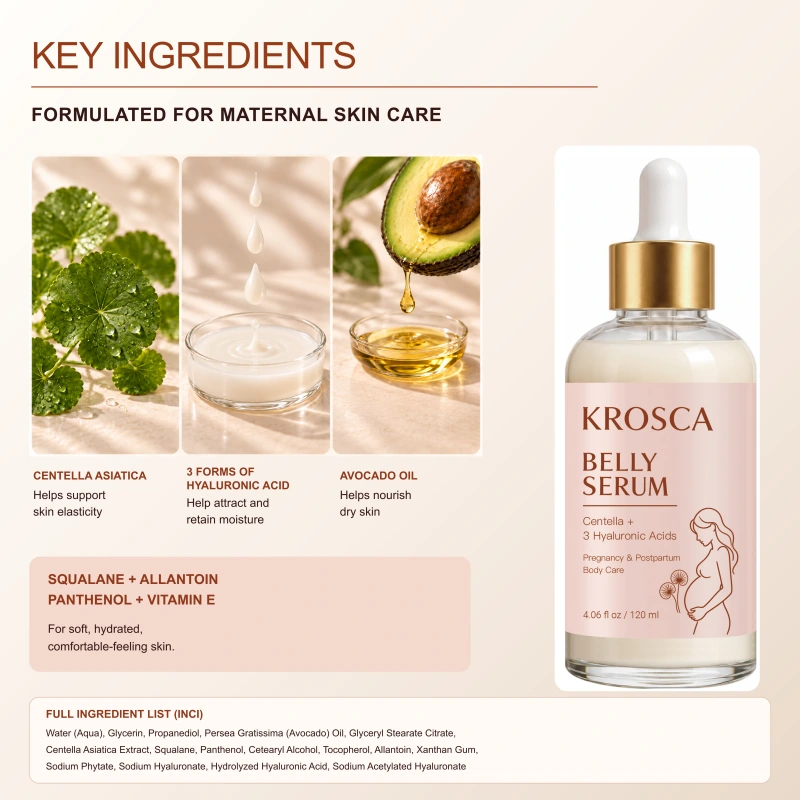
- Look for the full INCI, not a "key ingredients" box. If the site does not publish it, ask. A brand that will not list what is in the bottle is telling you something.
- Check the first five ingredients. That is 70–80% of the formula.
- Search the last five if you are avoiding something specific. Preservatives live there.
- Ignore the badges. "Clean", "natural", "pregnancy-safe" and "dermatologist-approved" are marketing unless there is a document behind them.
What we do
KROSCA Belly Serum is fragrance-free, with no essential oils and no drying alcohol. The full ingredient list is published on the product page [cuando la fórmula esté cerrada]. We do not use the phrase "pregnancy-safe", because we cannot certify safety for every pregnancy — we describe what is in it and you decide with your doctor.