Centella Asiatica for Skin: What It Does and What It Doesn't
Centella asiatica — also sold as gotu kola, cica, or TECA — is the ingredient the belly-care category is built on. It deserves a clearer explanation than "miracle plant".
What it is
A creeping plant from Asia, used in traditional medicine for wound healing. In cosmetics, the active part is a standardized extract of its triterpenes: madecassoside, asiaticoside, asiatic acid and madecassic acid. When a supplier says "TECA ≥90%", it means the extract is at least 90% those compounds.
What the evidence supports
- Barrier support and soothing. Several small studies show reduced irritation and improved barrier function in creams with centella extracts.
- Appearance and firmness. Small trials (often 20–40 people, 4–12 weeks) report improvements in skin firmness and in the appearance of stretch marks when centella is used consistently.
- Wound healing. The strongest evidence is in wound care, which is not the same as cosmetic use on intact skin.
What the evidence does not support: claims that centella prevents stretch marks, or that it produces visible change in a week.
Why concentration and standardization matter
"Contains centella" can mean 0.01% of leaf powder or 0.75% of a standardized extract. Those are not the same product.
Two things to check:
- The percentage in the formula.
- The standardization — the triterpene content, and whether there is a certificate of analysis behind it.
A brand that shows the percentage usually has a reason to.
What we use
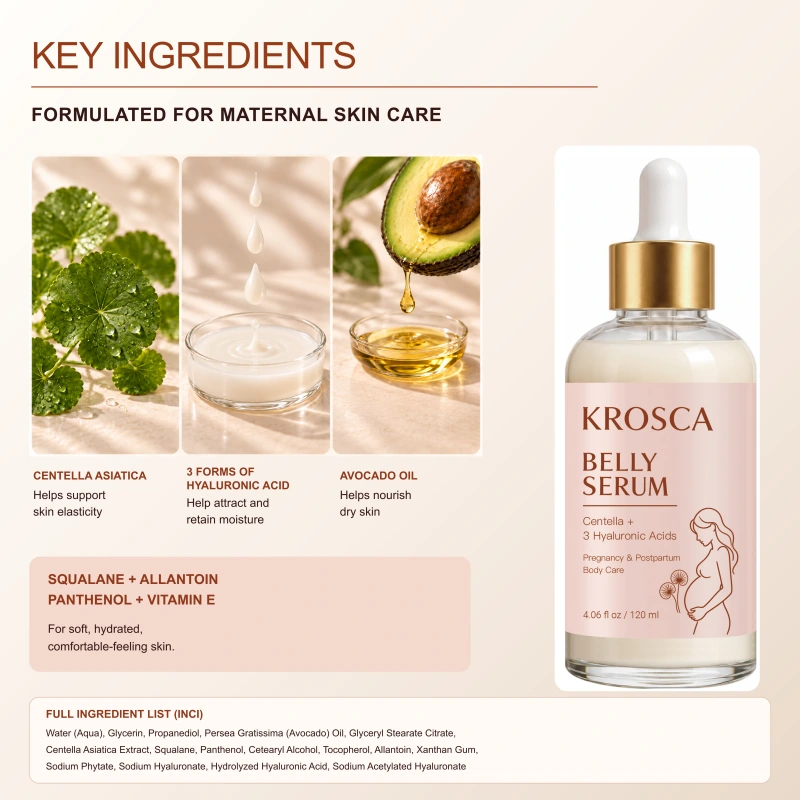
KROSCA Belly Serum uses 0.75% centella extract, standardized to ≥90% triterpenes (TECA). We chose the percentage for daily use over months, not for a dramatic claim. It is one of the reasons the serum is the daily step; it is not a reason to expect erased lines.
The honest summary
Centella is a reasonable, well-tolerated botanical with modest evidence for soothing and appearance. It is not a treatment. Anyone selling it as one is selling you the story, not the ingredient.